Shipping accounts for roughly three percent of global greenhouse gas emissions. However, its role in global trade makes it a critical sector in achieving climate targets. In recent years, the focus has shifted from setting ambitions to practical implementation – and at the same time, the discussion has moved from being technology-driven to increasingly financial in nature.
Regulation is reshaping the entire value chain
The International Maritime Organization (IMO) has defined the long-term direction of the sector towards net-zero emissions by around mid-century. In practice, this means a new regulatory framework combining mechanisms that control the greenhouse gas intensity of marine fuels with economic incentives and penalties.
At the same time, the European Union Emissions Trading System (EU ETS) and FuelEU Maritime regulation have already introduced a direct carbon price for shipping. This has significantly changed investment calculations across the industry. Emission reduction is no longer only an environmental consideration, but a factor that directly affects operating costs.
“Shipping accounts for
roughly three percent of
global greenhouse gas emissions.
The fuel race continues without a clear winner
Alternative fuels – including methanol, ammonia, bio-LNG, and synthetic e-fuels – continue to compete for a role in the future energy mix of shipping. No single global standard is in sight, which is pushing shipowners towards flexible solutions, often based on dual-fuel designs.
Methanol has advanced rapidly in practical adoption, largely because its handling and supply chain are relatively straightforward compared to many other alternatives. Ammonia, on the other hand, is widely viewed as a long-term solution, particularly for deep-sea shipping, but its deployment requires significant investment in safety systems and bunkering infrastructure.

Energy efficiency: the largest and often underestimated emissions reduction potential
While much of the attention is focused on fuels, a significant share of near-term emissions reductions will still come from energy efficiency improvements. Industry estimates commonly suggest that individual technologies typically deliver fuel savings in the range of 5–25 percent, although the actual impact depends heavily on vessel type, route, and operational profile.
For example:
- air lubrication systems can typically reduce fuel consumption by around 5–10 percent
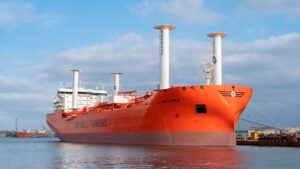
- rotor sails and other wind-assisted propulsion technologies can deliver savings of approximately 5–20 percent in optimal conditions on long-haul routes
- hull and propeller optimisation, along with other hydrodynamic improvements, can together provide around 5–15 percent efficiency gains
- digital voyage optimisation and operational performance management can contribute a few additional percentage points, often at relatively low cost
“Individual solutions alone
do not transform the overall picture,
but their combined effect can be significant.
Individual solutions alone do not transform the overall picture, but their combined effect can be significant. In practice, this is often referred to as a “technology package”, where the cumulative impact of multiple measures can exceed the effect of any single solution.
Overall savings can, in the best cases, rise well above 20 percent, and in some scenarios where multiple technologies are combined, even approach 30–40 percent. However, these effects are not directly additive.
This is why energy efficiency remains the fastest and most cost-effective way to reduce emissions, particularly in the early phase of the coming decade.
“Decarbonisation is also
a major financing challenge.
Costs are distributed across the value chain
Decarbonisation is also a major financing challenge, with costs distributed across multiple stakeholders rather than being carried by a single party.
Shipowners are primarily responsible for vessel investments and onboard operational systems, including fuel-related decisions and energy efficiency technologies. Charterers and cargo owners are increasingly sharing costs through green shipping agreements, where the emissions profile directly influences pricing and contract terms.
Port operators and infrastructure providers are investing in parallel in shore power systems, alternative fuel bunkering solutions, and new energy infrastructure enabling the use of fuels such as methanol, hydrogen, and ammonia. The public sector and EU-level funding instruments support this transition, particularly through pilot projects and infrastructure investment schemes, although the primary responsibility remains with market-based actors.
Financial markets have also become a key driver. Green loans, ESG-linked financing structures, and green bond instruments can reduce the cost of capital for shipowners, but they also increase reporting and transparency requirements across the value chain.

Ports are taking a more central role
Ports are becoming increasingly important in the transformation of maritime energy infrastructure. Shore power systems, storage and distribution facilities for alternative fuels, and emerging energy carriers require substantial investment, gradually shifting ports from purely logistical hubs into integrated energy nodes.
In the Baltic Sea region in particular, port development is closely aligned with EU climate policy, creating both regulatory pressure and new business opportunities.
“Ports are becoming increasingly
important in the transformation of
maritime energy infrastructure.
The transition is also an opportunity for the Finnish maritime cluster
The Finnish marine industry has a strong position in energy-efficient ship design, smart systems, and advanced marine engineering solutions. These areas are becoming increasingly important in a transition where success depends less on a single breakthrough technology and more on the integration of multiple solutions into viable system-level concepts.
Decarbonisation is no longer a future vision, but an ongoing industrial transformation. Competitive advantage will increasingly come from the ability to combine technology, operations, and financial realism. Over the next decade, the industry will determine which combination of solutions enables shipping to meet its climate targets – and in doing so, the competitive landscape of the entire maritime sector will be reshaped.
by: Editorial Team
photos: Pexels