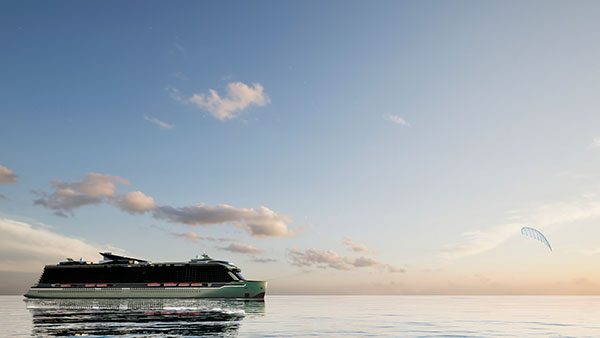
The net-zero emission cruise ship concept developed in the AVATAR project led by Meyer Turku has now been completed. The project achieved its emission-reduction target: the vessel’s lifecycle carbon footprint was reduced by more than 90 percent compared with the reference level defined by the International Maritime Organization (IMO). The results provide a strong foundation for continuing development and innovation work in sustainable shipbuilding.
Developing a net-zero emission ship concept was one of the key objectives of Meyer Turku’s four-year NEcOLEAP lead company programme, partly funded by Business Finland. The AVATAR project, which operated within the programme and concluded at the end of 2025, brought together a wide range of experts from different fields and demonstrated that Meyer Turku and the Finnish maritime cluster have excellent capabilities to develop the ships of the future in close collaboration across the entire ecosystem. The final outcome has also been critically evaluated by an independent external party.
“AVATAR has provided a strong foundation for our development work, and we now have access to a diverse range of new ideas, tools and next-generation shipbuilding technologies,” says Anu Ahola, Chief Strategy Officer at Meyer Turku.
The concept vessel incorporates technologies and solutions expected to be feasible by 2030. Technologies that are still in earlier stages of maturity were not included, yet the net-zero target was clearly exceeded.
“One single solution is not enough — for example, simply switching fuel does not achieve the desired impact. A net-zero emission concept is the result of many different factors,” explains Liina Vahala, Head of Product Development at Meyer Turku.
Significantly lower overall energy consumption
Minimising the ship’s energy consumption was at the core of the concept development. A digital twin – a dynamic energy simulation model – was used to compare the impacts of different solutions at the level of the entire system. The design emphasised a streamlined and lighter structure as well as improved energy efficiency of onboard spaces. For example, thanks to more energy-efficient ventilation units, the heating and cooling demand of cabin decks was reduced by approximately half.
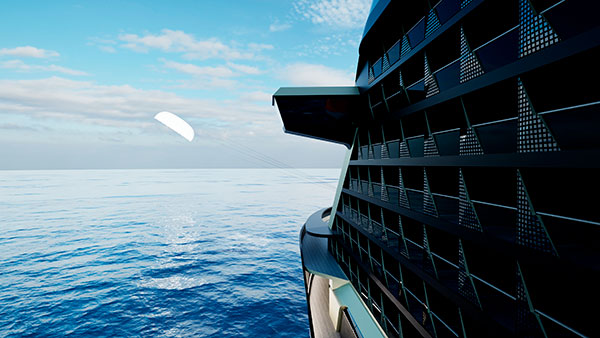
Biomethanol was selected as the fuel – a flexible transition fuel whose availability and environmental footprint are expected to improve over the vessel’s lifecycle. In addition, the concept vessel utilises wind-assisted propulsion technology and solar panels. Energy efficiency is further supported by sustainable material choices and efficient space utilisation, which together can significantly reduce the vessel’s lifecycle carbon footprint.
A new operating model for the future
“AVATAR should not be seen as just one project or concept, but as a new way of working for Meyer Turku. It is important that we continue to develop expertise related to net-zero emission ships across the entire maritime cluster and ecosystem,” Ahola concludes.
The AVATAR ship concept will be presented in more detail in April 2026 at the Seatrade Cruise Global exhibition in Miami.
Translated by Editorial Team.