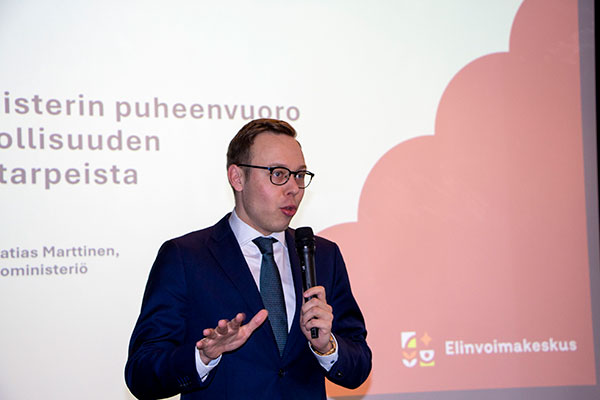
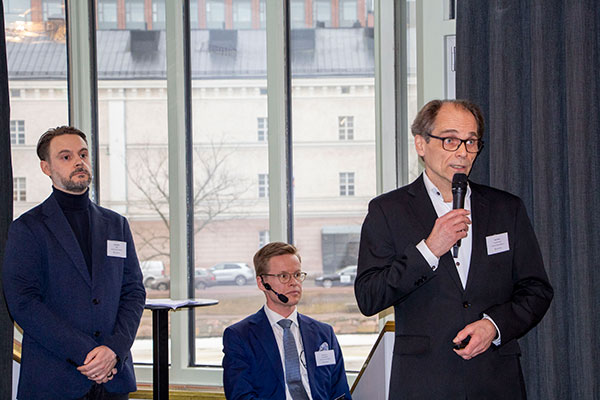
A maritime industry stakeholder event organized by the Economic Development Centre Uusimaa brought together key actors in the sector in Helsinki in March 2026. Speaking at the event, Minister of Employment Matias Marttinen highlighted the growth of the maritime industry and its critical importance to Finland’s competitiveness.
In his address, Marttinen emphasized the sector’s expansion and the opportunities it creates for Finnish expertise. He noted that the maritime industry network includes more than a thousand Finnish companies: “Specialization in the maritime industry is a question of employment for the whole of Finland.”
Marttinen also referred to his recent visit to North America and the strong appreciation for Finnish engineering expertise. He described the first Finnish maritime industry order from the United States as a significant opening. “The maritime industry’s order book is stronger than ever. It is important that we live up to the expectations placed on us. You will receive full support and assistance from the Ministry of Economic Affairs and Employment,” he assured the companies present.
According to the minister, the sector will need thousands of new employees over the next decade, and the government is strongly committed to supporting business growth, access to skilled labor, and export expansion.
The role of education, attractiveness, and communication in meeting talent needs
Researcher Niko Pagkratis and business expert Petri Pohjala from the Economic Development Centre Uusimaa outlined developments in competitiveness factors and skills needs within the regional maritime industry. Due to geopolitical changes, demand has shifted toward Western countries, and there is intense competition for electrical engineering professionals.
Pohjala noted that the Centre’s Vientikunto coaching program supports companies in internationalization, productization, and marketing: “Around 100 SMEs are involved, some of them from the maritime cluster.” Uusimaa has the potential to position itself as a hub for Arctic maritime technology, high value-added lifecycle services, and sustainable maritime industry systems and expertise.
According to Pagkratis, the need for higher education will grow, and the education structure in the field must be strengthened to meet demand.
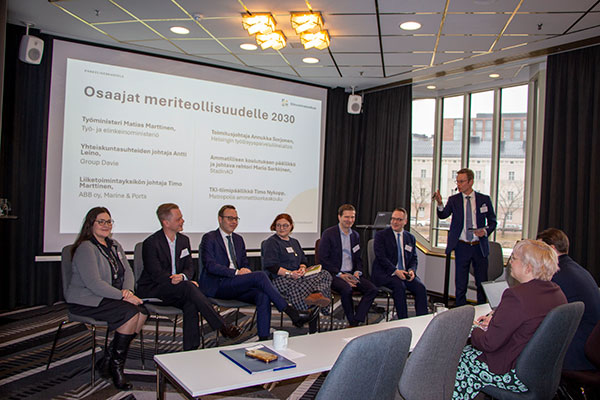
Panel discussion: how to ensure the availability of skilled labor?
The panel brought together companies, educational institutions, and public sector actors. The discussion highlighted the need to strengthen education pathways, attract young people, and ensure better integration of international talent.
Annukka Sorjonen, CEO of Helsinki Employment Services, pointed to the regional situation: “There are 76,000 job seekers in Helsinki. The question now is how to encourage them to pursue further training in the maritime industry.” She also described practical cooperation with the shipyard in recruiting suitable candidates.
Timo Nykopp, RDI Team Manager at Metropolia, identified conversion training for highly educated unemployed individuals and more hands-on learning as key solutions: “We have failed in branding the engineering field. When education includes concrete tasks, it opens people’s eyes to what their skills can achieve.”
Maria Sarkkinen, Principal and Head of Vocational Education at Stadin AO, highlighted the importance of early guidance for young people and Finnish-language work environments: “The city has a great opportunity to spark interest in maritime careers early in the education path.” She also emphasized that a shared working language is part of occupational safety, noting that skills demonstrations at their institution are conducted in Finnish.
Sorjonen also stressed the strong support available for apprenticeships: “Financial support is available—employers should stay alert,” she advised.
Antti Leino, Director of Public Affairs at Group Davie, underlined the industry’s international competitive landscape: “Davie already collaborates extensively with educational institutions. Growing demand in North America and the revival of shipbuilding open significant export opportunities for Finnish companies and expertise.” He also emphasized the importance of quality: “We must move away from the mindset of producing at the lowest possible cost.”
Timo Marttinen, Business Unit Manager at ABB, highlighted variations in students’ skill levels and the importance of maintaining working-life skills: “The industry needs innovation and new solutions. Innovation is the key competitive advantage driving maritime industry growth.”
Minister Marttinen stressed that companies must act early in anticipating their workforce needs. Regarding young people and industry perceptions, he emphasized the importance of communication: “The maritime industry also offers many white-collar roles. We need to change perceptions of the sector.”
On international talent, Marttinen stated: “There is a national will to increase the share of Finnish workers in the maritime industry workforce.” He emphasized prioritizing domestic labor solutions and the importance of language training models.
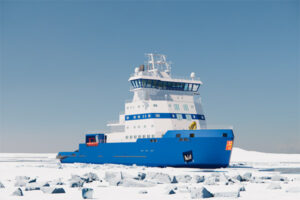
The minister also highlighted the state’s role in vessel procurement: “Keeping shipyards’ core production viable benefits the entire network of companies.” He noted that the procurement of the Aino icebreaker is about to begin and reminded of the urgent need to renew the icebreaker fleet.
Stronger city involvement in supporting the maritime cluster
According to Annukka Sorjonen, Helsinki will appoint a specialist in April dedicated solely to the maritime cluster.
“Helsinki is Finland’s largest and most diverse maritime cluster hub. Specialized expertise requires new types of education and tailored training solutions,” Sorjonen said.
The city aims to accelerate tailored education, youth guidance, and support for companies in recruitment.
Translated by the Editorial Team.
Source: Economic Development Centre Uusimaa