
Minister Sakari Puisto: Finnish maritime competitiveness is anchored by performance, quality – and reliable, speedy vessel delivery
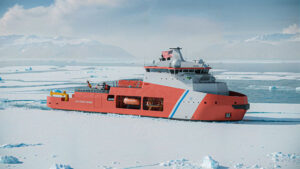
The United States relies on Finnish expertise to create an icebreaker armada for its Coast Guard. According to a new deal struck between Finland and the USA, four icebreakers will be built in Finland and seven in the United States. The icebreaker order is a concrete example of long-term cooperation between Finland and the United States and will also serve to boost cooperation within the ICE Pact between Finland, the United States and Canada. SEATEC interviewed Sakari Puisto, the Finnish Minister of Economic Affairs, about the significance of the contract.
Why is Finland so strong in arctic shipbuilding?
– The strength of Finnish shipbuilding lies the strong role of the subcontracting network. Eventually, when icebreakers are built in the United States, too, it is very likely that a large part of this subcontracting network will also be involved there. This thinking is based on the fact that the ships are designed right here in Finland.
What icebreaker expertise do Finns have that is unique in the world?
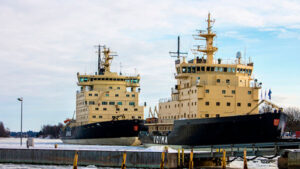
– Icebreakers are very special ships that require their own unique design and numerous devices that are specific to icebreakers. For example, the powerful propellers and shafts are designed and built to withstand very heavy loads. The ship’s hull is durable and specially shaped so that it can break the ice in the first place. There are solutions on icebreakers that are not found on other ships at all.
The icebreaker industry has gradually developed in Finland, and we have special design expertise and product development for all kinds of icebreakers. Our shipyards have also built many of these, and they have accumulated a lot of practical know-how for building icebreakers.
The icebreaker expertise is embedded in companies, research institutes and the professional workforce. It forms a unique entity that is at the core of our competitiveness.
“The strength of Finnish shipbuilding
lies the strong role of the
subcontracting network.
Looking beyond icebreakers, why is Finland so strong in the shipyard sector – including cruise ships, military vessels?
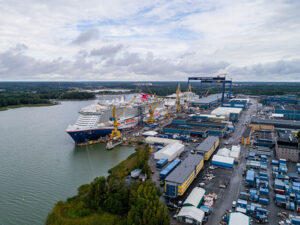
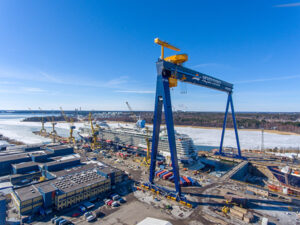
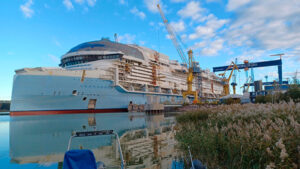
– Icebreakers have been built in Finland even before World War II and other ships before that. Shipbuilding has never stopped in Finland, which is why we now have three shipyards that build large cruise ships and warships, as well as icebreakers.
These shipyards have a subcontracting network with various top-level expertise. The companies in the subcontracting network are not mainly dependent on Finnish shipyards – they also supply services and products globally for various ship projects.
Furthermore, Finland has a long tradition of strong engineering education and maintains an innovative environment to develop operations. Our shipyards have also had to operate in the international market according to its terms, so investments in competitiveness have been necessary.
We’ve found that high-tech products perform particularly well. Each project takes the industry forward and increases our know-how and competitiveness.
Do you believe that more maritime innovations will be coming out of Finland in the future?
– I believe that continuous work and a constant desire to improve and enhance performance – as well as the introduction of new technology – provide a good platform for creating new services, products and innovations.
However, innovation is not only about increasing competitiveness, but also about defending it. You learn also by doing, so the new icebreaker contract is certainly important in that sense. With the orderbook filling up, it is easy to say that there will definitely be more innovation and new cutting-edge solutions.

From a foreign perspective, the Finnish marine ecosystem may seem exotic – but to Finns, collaboration is pretty much second nature. Why does this collab model work here but not necessarily elsewhere?
– Finland has a very significant maritime industry in relation to the size of the country. There are strong marine ecosystems elsewhere, for example in Norway, which specializes in off-shore vessels. Both of these countries have built ships, and several hundred significant companies have emerged from the shipbuilding sector, each with their own specialist expertise and products.
However, it can be said that a significant number of equipment suppliers and subcontractors are needed around the shipyards. For the construction of icebreakers, very specialized suppliers are needed, and they are mainly located in Finland.
The icebreaker deal gives clear indication of Finland’s expertise and competitiveness in the world. At the heart of competitiveness there are performance, quality, and both fast and reliable delivery times of the vessels.
Thanks to the subcontractor network, the role of shipyards is increasingly that of a coordinator now?
– I wouldn’t say it’s a coordinator role. The shipyard is the company that is entirely responsible for building the ship and delivering it to the customer. Today’s shipyards do rely heavily on equipment suppliers and subcontracting in various areas of construction.
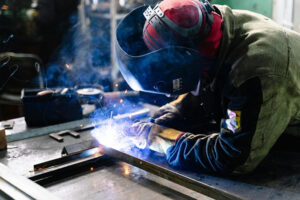
However, shipyards mainly build and assemble the ship’s hull themselves in their own construction pool. The shipyard has to manage the huge procurement process, logistics and the organization of the entire work in construction, and handle quality assurance and financing.
“Finland has a very significant
maritime industry in relation
to the size of the country.
Do you believe that Finland will be the number one country in icebreaking for decades, even though some of the ships are built in the United States?
– Finland will continue to be the number one country and the demand for ships will grow. Climate change has a significant impact on the Arctic and Antarctic regions, but its effect on icebreaker demand is perhaps the opposite of what first impressions might suggest. In the Arctic regions, global warming has led to the possibility of cargo traffic passing through the region.
The Arctic region is also geopolitically hot for other reasons, including the region’s mineral reserves that can increase shipping in the region. As the Arctic region sees an increasing number of merchant and military ships from different countries, the need for these countries to secure the passage of their ships increases, and thus the need for icebreakers increases.
You were at the ICE Pact icebreaker cooperation ministerial meeting between Finland, the United States and Canada in Washington D.C. in November – what was the key take-away?
– At the meeting, the new US administration showed clear support for the Ice Pact cooperation that began during the previous administration. In the discussions, great power politics in the Arctic regions came up more clearly than before. For countries operating in the Arctic regions, icebreaking capability is essential. Through Ice Pact, the United States strengthens its own capability. At the same time, through cooperation, other like-minded countries can also benefit from the growing icebreaker production and development that Ice Pact promotes. Once again, it became clear how unique Finland’s expertise in the icebreaker field is.
by: SAMI J. ANTEROINEN
photos: LAURI HEIKKINEN / PRIME MINISTE’S OFFICE.