Marine propulsion has long followed a familiar pattern: engines, shafts and propellers arranged around established mechanical principles. While energy systems in other sectors have evolved rapidly, vessel propulsion layouts have remained largely unchanged — with all the associated trade-offs in space, noise, maintenance and design flexibility.
Electric propulsion is now challenging that status quo. Among the various technologies entering the market, pod-based systems are attracting growing interest because they combine electric drivetrains with highly flexible underwater propulsion. Rather than adapting electrification to legacy architectures, pods rethink the propulsion layout itself.
Rethinking the Propulsion Architecture
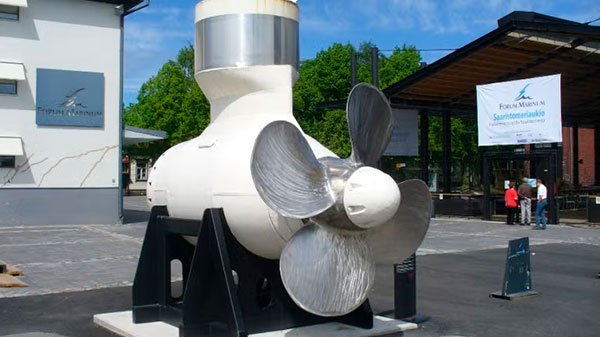
In a pod configuration, the electric motor is integrated directly with the submerged propeller unit. This eliminates long shaft lines, gearboxes and complex mechanical transmissions. Because electric motors do not require combustion air or continuous idling, they can operate efficiently in fully enclosed underwater housings.
The result is a cleaner system layout with fewer mechanical interfaces, reduced vibration and lower onboard noise levels. From a design perspective, pod propulsion also frees up internal space that would traditionally be dedicated to engine rooms and shaft arrangements. For operators, this can translate into improved usability, simplified maintenance pathways and greater flexibility in vessel configuration.
Rotatable pod units further enhance manoeuvrability by directing thrust precisely where it is needed. This capability can reduce or even eliminate the need for conventional steering systems, supporting tighter handling characteristics and more responsive control.
Power Density Unlocks Broader Applications
Despite these advantages, pod propulsion has historically faced limitations related to hydrodynamic drag. Because the system is submerged, its physical size directly affects resistance. Earlier generations of electric motors required relatively large volumes to deliver useful output, which restricted pods mainly to specific vessel segments.
The key constraint has been motor power density — the amount of power generated per kilogram. Lower-density motors meant larger pods and increased drag, which reduced overall efficiency benefits, particularly in smaller vessels or longer-range operations.
Recent advances in electric motor technology have significantly improved this equation. Modern high-density motors deliver substantially more power with less mass and smaller cross-sectional area. As a result, drag increases more slowly than available power, improving scalability and expanding the practical use cases for pod systems.
With continued improvements in motor technology, pod propulsion is increasingly seen not just as an alternative drive system, but as a structural enabler of marine electrification — one that can reshape vessel design principles rather than simply replacing conventional engines.
by: EDITORIAL TEAM