Meyer Turku is enlisting the aid of universities in pursuit of more sustainable shipbuilding
Meyer Turku is intensifying its collaboration with the academic world. The latest move involves deepening the long-standing cooperation with Åbo Akademi as a new partnership agreement was signed.
The agreement period is five years, and
the focus lies, at least initially, on Åbo
Akademi’s Faculty of Natural Sciences and
Technology and Meyer-led green transition
program NEcOLEAP. Meyer Turku collaborates
also with two other local universities,
University of Turku and the Turku University
of Applied Sciences, along with most
universities across the land.
Ilkka Rytkölä, Ecosystem Lead at
Meyer Turku, is especially excited about the
launch of Green Transition Lab – a shared
workspace which supports the interaction
between researchers and industry. Located
in Data City in Turku, Green Transition Lab
opened its doors in March 2024 and has
hit the ground running:
“There’s been dozens of events and
meetings at the Lab already and services
available for startups, for example,” Rytkölä
says.
Kim Wikström, Professor of Industrial
Engineering and Management at Åbo
Akademi, is equally pleased with Green
Transition Lab as a solid example of widespanning
collaboration.
“Via Green Transition Lab, we pursue
a systemic approach, with hopefully a
variety of benefits to come. We are looking
for new initiatives targeting even radical
innovations,” Wikström says.
PROFESSORSHIP IN THE WORKS
In addition to the Lab, the new partnership
agreement includes e.g. doctoral student
positions and a range of courses adapted
for lifelong learning in the shipbuilding
industry – as well as a sponsored professorship.
“We’re in the process of appointing
the professorship in sustainability that
Meyer Turku will finance, with a particular
focus on process technology, energy
technology and industrial engineering and
management,” says Wikström, adding
that the collaboration is a very significant
one from the perspective of the university.
“We will fill the professorship by the
end of the year,” he believes.
DIGGING DEEP
Talking about ways to cut down carbon in
the marine industry, Wikström acknowledges
that green fuels are trending very
strongly, but there are other sustainable
moves to make, too.
“Use of space on ships is one issue.
If you rethink functions in the ship’s public
areas and cabins, you can achieve surprising
results,” he says. For example, instead
of ships having laundry services onboard,
would it make sense to do the laundry on
the shore?
Another development area involves
digitalization and Big Data. “With all the
information available, we can manage and
optimize the flow of people on ships.”
The big thing on the backburner is
making ships out of green steel. “Ships
require vast amounts of steel, so making
that steel in a carbon-neutral way would
be a tremendous improvement,” says Wikström.
Green steel fleets are still probably
decades away, but in terms of competitive
advantage, it makes sense to be among
the early adaptors in this field. “Also regulation
keeps tightening and it helps to
be proactive, instead of just following the
pack.”
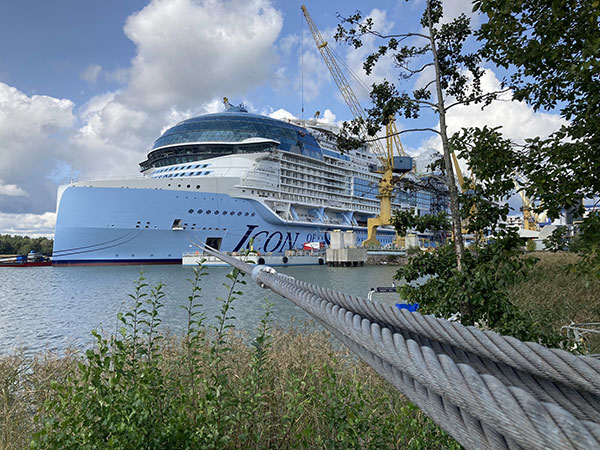
NECOLEAP PUSHES
MARITIME R&D
The new collaboration fits seamlessly
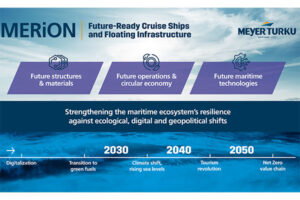
into the wider framework of NEcOLEAP,
the green transition lead program which
kicked off in 2022. In the Business Finland
funded program, Meyer Turku heads
a group of companies, universities and
research institutes in order to develop
innovative and sustainable technological
solutions for the needs of the maritime
industry. The program will run until 2025.
The research and development topics
within the NEcOLEAP program focus on
four areas: the designing of the cruise
ship itself, the shipyard’s operations, i.e.
the different phases of shipbuilding, and
the introduction of smart technologies
and the open-minded professionals of
the future.
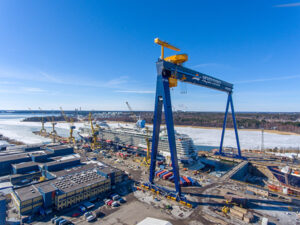
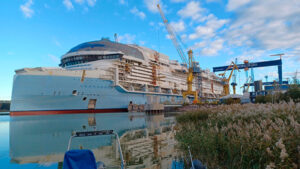
Regarding the shipyard, the goal is
to develop the concept of a carbon-neutral
cruise ship by 2025 and make the
entire shipyard climate-neutral by 2030. Ilkka Rytkölä recognizes that the goals are
ambitious.
“We’ve set the target high and it’s
not going to be easy. Nevertheless, we
believe that it is possible.”
ECOSYSTEM EDGE
Rytkölä agrees with Wikström that it’s ‘all
hands on deck’ in bringing down carbon:
you need more sustainable fuels, materials,
processes…
“Clearly it is something you can’t do
all by yourself. We need the entire marine
ecosystem to pull together in this one,”
Rytkölä says, pointing out that the shipyard
serves as the master coordinator and integrator
of a shipbuilding project – while the
suppliers within the vast ecosystem provide
the products.
“We have suppliers that vary in size a
lot and have different access to resources,
but it’s also true that especially the smaller
companies can be very creative in cutting
down CO2 emissions,” he says.
Rytkölä also points out that looking
at the lifespan CO2 emissions caused by
building and running cruise ships, only 5%
come from the actual shipyard operations.
“We have to look at the entire big
picture to see where we can make the biggest
impact.”
UNITED WE SAIL
Both Wikström and Rytkölä see strategic,
long-term collaboration as the key to
marine industry’s sustained success.
“Local universities are keen on collaboration,
but also, for instance, Aalto,
Tampere and Oulu universities are contributing
to the work,” Wikström says,
emphasizing the importance of having
broad shoulders. “We have a very diverse
competence platform.”
Approaching this equation from the
business side, Rytkölä views the Finnish
marine cluster as a very powerful difference-
maker:
“We have a very special ecosystem
with unique strengths and common coals.
It’s unlike anything else out there,” he says.
by: SAMI J. ANTEROINEN
photos: MEYER TURKU OY