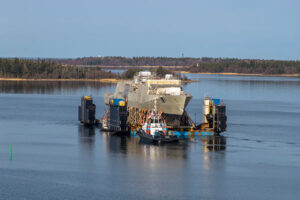
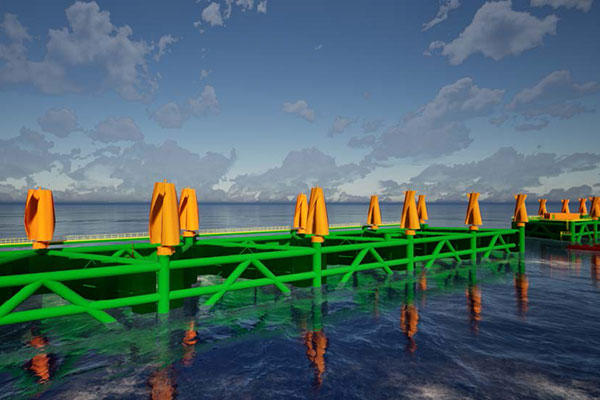
“This exiting project describes how we could use our oceans, not only for coastal protection, but also for the production of food and energy”, says Poulose.
The area houses automated fish feeding and harvesting systems, environmental monitoring and control facilities for aquaculture activities. It also includes floating solar arrays and wind turbines, serving as the central energy management hub of the facility.
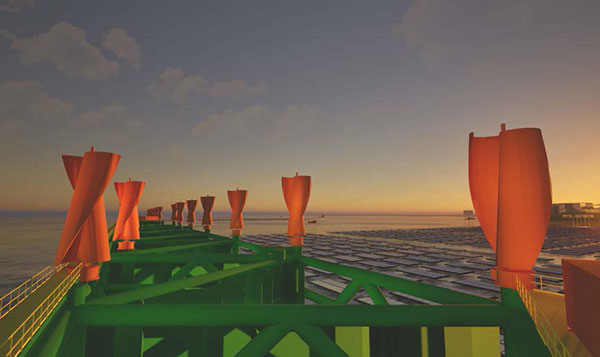
The design incorporates vertical-axis Windside wind turbines, which are capable of operating efficiently in close proximity to one another. Windside turbines were selected because of their long operational history in marine environments, ability to operate in both strong and low wind conditions, safety issues, low vibration characteristics, and capability to capture wind from multiple directions. The platform movement is not expected to affect turbine performance, either.
Mr. Poulose highlights the positive impact on coastal areas: “The breakwater absorbs and reduces the impact of strong ocean waves, helping to protect coastal areas from erosion. Over time, sediment carried by the sea can accumulate behind the structure, creating opportunities for natural beach formation and shoreline restoration.”
He also emphasizes that the calm water basin enables the cost-effective deployment of additional floating infrastructure for industrial activities, commercial developments, tourism facilities, and other marine-based industries, andhelps protect fishing communitiesby providing calmer waters.
When asked why Windside turbines instead of traditional ones, Poulose said: “Safety issues and trust in the technology were the most important considerations. Windside’s more than 40 years of experience in demanding marine environments was impressive. We wanted a solution with a proven track record. The investment in quality and durability today can contribute to lower maintenance and repair requirements over the long term.”
One Breakwater platform would include ca. 60 wind turbines with height of 10m each.
The installation concept described is referred to as a Windside Linear Power Station (LPS). Floating platforms with safe and soundless Windside turbines would be a future solution for sensitive coastal areas.
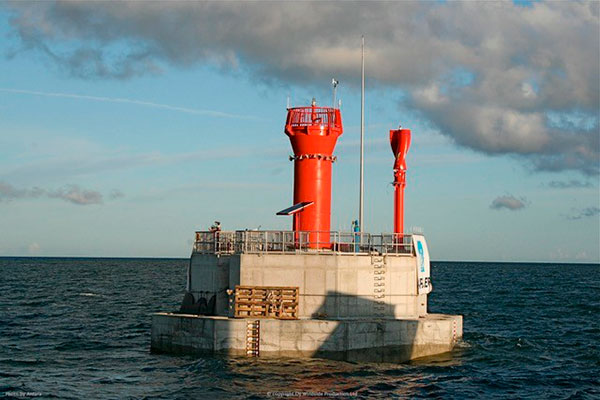
Over more than four decades of operation, Windside turbines have been used in marine and coastal environments including e.g. lighthouses, navigation buoys, vessels, and port facilities. They are used also in several breakwater systems of small scale.
More information at: www.windside.com
| Key Facts: |
|---|
Windside is used by e.g. Since 1982 Windside has equipped Platforms, light houses, vessels, harbors, research centres, telecom, radars Produces at 2m/s up to 60m/s Specifically designed for low cut-in wind speeds and no cut-out at extreme wind speeds. Production also in storms. 25+ year offshore lifespan Built of heavy-duty reinforced fiberglass, marine-grade aluminium, hardened steel, fully galvanized frames, high-quality bearings, and sealed electronics. Up to 5 years maintenance-free Optional automatic lubrication system extends maintenance intervals to 5 years. Silent, vibration-free and safe Perfectly silent, less than 5dB. Balanced for zero vibration. Safe to touch at all speeds. Patented technology www.windside.com |