Finnish Marine Technology

Blue ocean strategy requires green core

Marine industry is turning more low-carbon and future-proof by the minute – at least in Finland. The Finnish marine industry is well-known for its green solutions to reduce the emissions of all things marine, but lately, the sustainability angle has become, well, a lot more than just an angle. Sustainability is in the core of the entire industry.

The sustainability push is spearheaded, at least in part, by the Finnish
Marine Industries’ ResponSea initiative which focuses on reducing the
environmental impact of shipping and shipbuilding, continuous development
of the industry’s companies as fair employers, monitoring the sustainability of
the delivery chain and enhancing circular economy and lifecycle efficiency in all
actions.

ResponSea encourages the companies of a rather heterogeneous industry
to define their own commitments for accomplishing the goals of sustainable
development – and, at the same time, to develop the companies’ green
operations. In addition, the program monitors the industry’s sustainability
progress.

Major industry players are certainly doing their share in the green
transition. In June, Wärtsilä Corporation opened its new technology centre, the
Sustainable Technology Hub, (STH) in Vaasa, Finland. The new €250 million
centre contributes to efforts to advance the global decarbonisation of marine
and energy by fostering innovation, collaboration, and the development of
green technologies using sustainable fuels and digital technologies.

Håkan Agnevall, President and CEO of Wärtsilä, remarks that by taking
advantage of innovative technologies that already exist today, we can speed
up the development of future-proof engines capable of running on sustainable
fuels. Wärtsilä is eager to demonstrate that a carbon neutral future is
achievable.

In fact, Wärtsilä already has engines operating on carbon neutral fuels.
This year the company released its Wärtsilä 32 Methanol engine to the market,
and in 2023 an ammonia concept will be ready. A hydrogen concept is
expected to be available in 2025.

Another recent, green example comes courtesy of Steerprop who
announced a major order in August. Steerprop will supply the complete
propulsion package for a state-of-the-art Wind Installation Vessel (WIV) for
Sembcorp Marine Ltd. Singapore-based Sembcorp is building the vessel for
Maersk Supply Service of Denmark.

The order builds upon Steerprop’s extensive track record in delivering fitfor-
purpose solutions to the offshore renewables sector.

The company’s scope includes six of Steerprop’s ducted L-drive azimuth
propulsors with an output power of 4,500 kW and two 900 kW Steerprop
Tunnel Thrusters for dynamic positioning, manoeuvring, and transit operations.

Sustainable innovations are no longer niche nor marginal – let the green
winds blow!

PETRI CHARPENTIER
Share this article: 

Environment

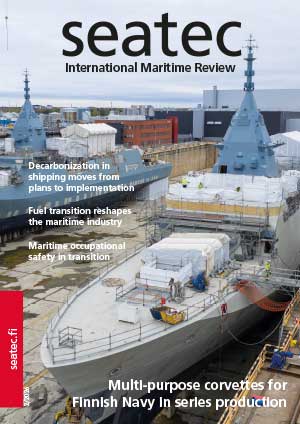
Decarbonization in Shipping Moves from Plans to Implementation

International shipping is entering a phase where reducing greenhouse gas emissions is no longer a long-term ambition, but a concrete part of everyday business operations. Regulatory pressure is increasing, technologies are advancing, and investment decisions are being made in an environment marked by uncertainty, where the distribution of costs has also become a central issue.

Meyer Turku’s New MERiON Program Guides the Maritime Industry Amid Upheavals

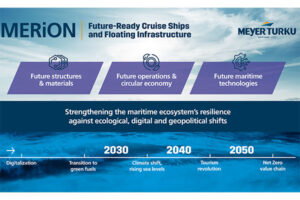
Meyer Turku is launching a five-year MERiON lead program, co-funded by Business Finland, which focuses on strengthening the shipbuilding industry through ecological, digital and geopolitical changes. The program brings together the existing maritime network as well as new business sectors to develop solutions for cruise ships and floating infrastructure.

Fuel Transition Reshapes the Maritime Industry

The maritime sector is undergoing its most significant energy transition to date. While multiple low-carbon fuel pathways are emerging, no clear winner has yet been established. Methanol, ammonia, LNG, biofuels, and synthetic fuels are all competing for position as the industry responds to tightening regulation and long-term decarbonization targets.

Editorial: Green Transition and Technology Define the Future of Finnish Maritime Industry

The maritime industry is entering a decade of profound transformation. Climate targets, geopolitical shifts, digitalization, and rapid technological development are reshaping the way ships are designed, built, and operated. For Finland, these changes are not merely challenges to overcome—they are opportunities to strengthen our position as a global leader in maritime innovation.

Decarbonization in Shipping Moves from Plans to Implementation

International shipping is entering a phase where reducing greenhouse gas emissions is no longer a long-term ambition, but a concrete part of everyday business operations. Regulatory pressure is increasing, technologies are advancing, and investment decisions are being made in an environment marked by uncertainty, where the distribution of costs has also become a central issue.

Meyer Turku’s New MERiON Program Guides the Maritime Industry Amid Upheavals

Meyer Turku is launching a five-year MERiON lead program, co-funded by Business Finland, which focuses on strengthening the shipbuilding industry through ecological, digital and geopolitical changes. The program brings together the existing maritime network as well as new business sectors to develop solutions for cruise ships and floating infrastructure.

Fuel Transition Reshapes the Maritime Industry

The maritime sector is undergoing its most significant energy transition to date. While multiple low-carbon fuel pathways are emerging, no clear winner has yet been established. Methanol, ammonia, LNG, biofuels, and synthetic fuels are all competing for position as the industry responds to tightening regulation and long-term decarbonization targets.

Editorial: Green Transition and Technology Define the Future of Finnish Maritime Industry

The maritime industry is entering a decade of profound transformation. Climate targets, geopolitical shifts, digitalization, and rapid technological development are reshaping the way ships are designed, built, and operated. For Finland, these changes are not merely challenges to overcome—they are opportunities to strengthen our position as a global leader in maritime innovation.