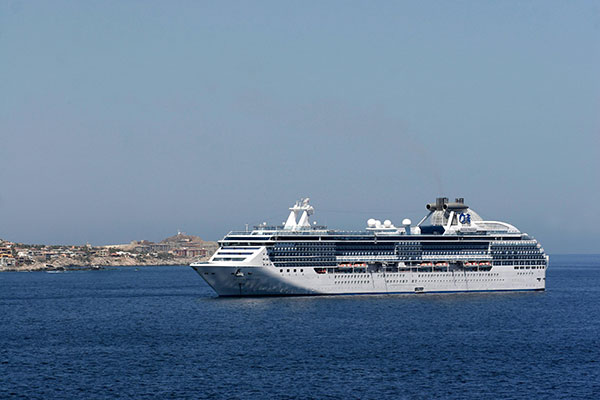
Tools for calculating ship emissions and assessing their environmental impact have become increasingly comprehensive. The research helps estimate what emissions might look like in the future if ships were required to use low-emission fuels. The data is also widely used outside Finland.
Lasse Johansson, D.Sc. (Tech.), a senior researcher at the Finnish Meteorological Institute, defended his doctoral dissertation at LUT University in Lahti on Friday, September 12. His research focused on collecting and utilizing ship emission data for environmental impact assessment.
Johansson has studied ship emissions, their climate effects, and urban air quality for more than a decade. In addition to the Finnish Meteorological Institute, his research results are used by the Baltic Marine Environment Protection Commission (HELCOM), the International Maritime Organization (IMO), the European Centre for Medium-Range Weather Forecasts (ECMWF), and the European Maritime Safety Agency (EMSA). In the near future, the data will also contribute to the work of the Intergovernmental Panel on Climate Change (IPCC).
“I have developed emission monitoring models as well as their local and global applications. These tools are primarily used by the Finnish Meteorological Institute. In practice, we produce data on the environmental pressures caused by ships, which, for example, European air quality modelers use as one of their data sources. The information is also included in global emission inventories maintained by the EU,” Johansson explains.
Data to support decision-making
The STEAM model, which describes ship emissions, examines each vessel individually and uses location data from the ships’ Automatic Identification System (AIS). The ships’ technical characteristics are retrieved from commercial databases. The model can also be used to simulate future scenarios—data that is essential for supporting decision-making.
“The model calculates current ship emissions, but it can also simulate what emissions would be in the future if global regulations required ships to use lower-emission fuels. Both current and future scenarios are used in global impact assessments when considering potential regulations and their health, environmental, and climate benefits,” Johansson says.
A separate tool for monitoring urban air quality
Johansson has also contributed to the development of urban air quality monitoring. The ENFUSER model, which describes urban air quality, is used for continuous air quality monitoring in the Helsinki metropolitan area. Real-time results are available on the Helsinki Region Environmental Services Authority (HSY) website.
“There’s an open-source version of the urban air quality model available on GitHub, so anyone could make use of it. Informally, the model also covers Tampere and Turku. We’ve also conducted pilot projects abroad, such as in Nanjing, China, and Delhi, India. Naturally, we incorporate modeled ship emissions whenever there is maritime traffic near the modeled area,” Johansson adds.
More information: lasse.johansson@fmi.fi
Translated by the editorial team.
Source: Curious People -newsletter and LUT University