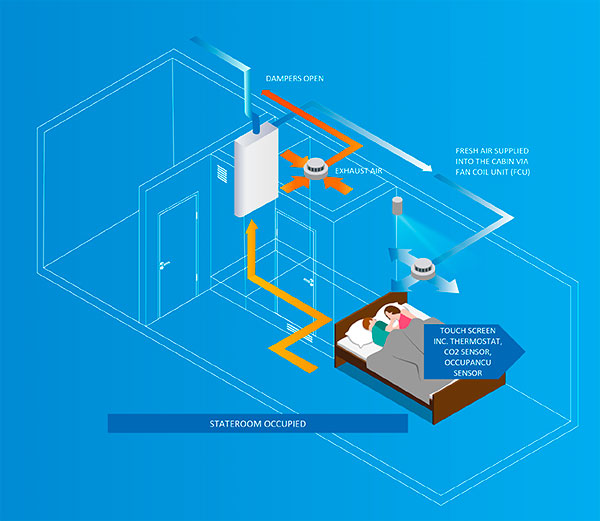
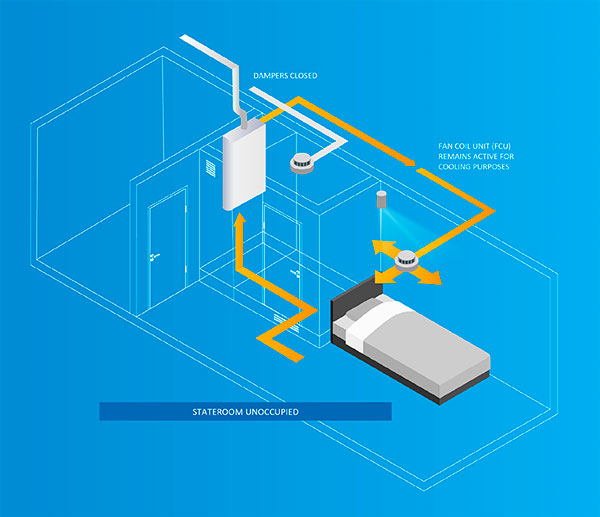
Occupancy-based ventilation supports sustainable marine industry by combining energy efficiency and passenger comfort. The solution uses data from cabin conditions – such as temperature, humidity, CO₂ levels, and occupancy – to optimize ventilation needs via automation. When the cabin is unoccupied, ventilation can even be completely shut off, without compromising indoor air quality.
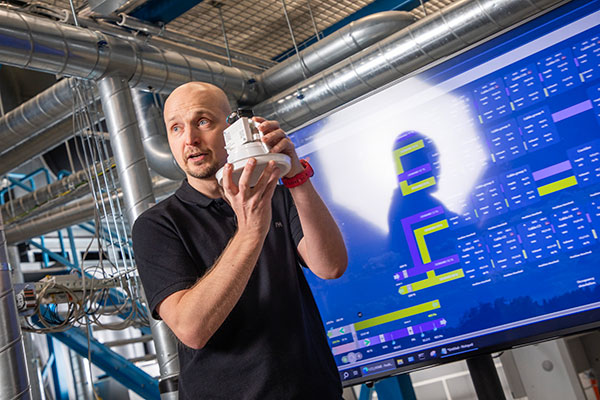
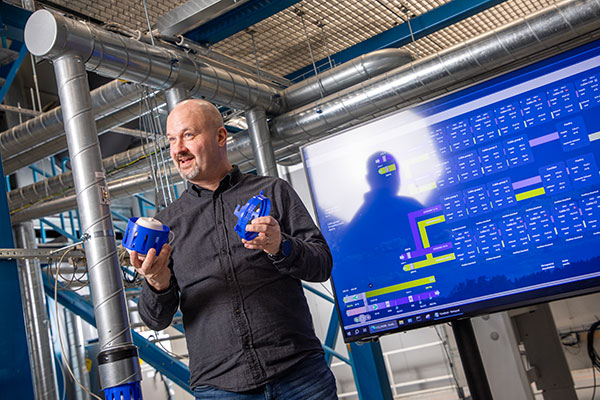
Koja Marine Business Area Manager Jere Vähämäki explains that the OBV solution automatically adjusts ventilation based on actual occupancy – adapting in real time to whether the cabin is in use or not.
Patented excellence
OBV is protected by an international patent (EP3591302B1), covering automatic control and energy-saving logic.
“We received the patent in 2021,” adds Vähämäki. The technology has been developed and tested in Finland.
Vähämäki points out that the importance of energy efficiency comes as no surprise to anyone in the marine industry. As air conditioning accounts for about 24% of a ship’s total electricity consumption, it is an obvious target for savings.
“We’ve been working on this concept for ten years, but the more intense development phase kicked in around 2019,” Vähämäki explains.
Collaboration kicks off with Carnival Maritime
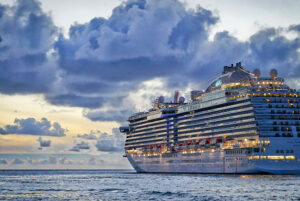
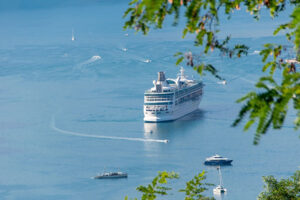
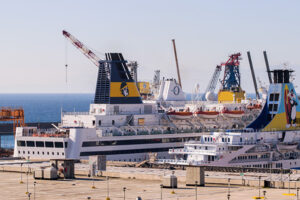
As the Koja R&D became convinced of the viability of concept, the attention turned to finding a suitable pilot. In 2024, the right partner and the right project were found at Carnival Maritime GmbH – a member of Carnival Corporation and responsible for the maritime operations of some of its cruise lines. Aboard one of the cruise ships supported by Carnival Maritime, an area of 100 cabins was fitted with the OBV system.
Gabor Gulyas, Senior Energy Manager at Carnival Maritime, explains that as the project was initiated, the data clearly showed that legacy systems were “vastly over-ventilating” in unoccupied cabins. Carnival was eager to see if Koja’s expertise could bring some relief into the situation.
The pilot project achieved up to 44% energy savings in the cabin area air conditioning, exceeding even Koja’s own expectations.
“The pilot clearly demonstrated the effectiveness of occupancy-based ventilation,” says Jere Vähämäki.
Bigger projects with strategic reach
The next project saw 500 cabins being “OBV’d” in 2025, followed by giving the full OBV treatment to an entire ship (2,000 cabins) the same year. While the amount of cabins grew, the achieved energy savings remained considerable.
The results were not a surprise, but rather a validation of a calculated, strategic execution, says Gabor Gulyas. He points out that true efficiency and savings are rather dynamic and really depend on boundary conditions like seasonal ambient conditions, operational settings and itinerary occupancy.
“We have successfully proven that we can aggressively de-risk our hotel load and drive decarbonization goals without compromising guest comfort or compliance,” Gulyas explains.
Marco Torkler, Director, Technical Projects & Operational Support, for Carnival Maritime, says that the design, planning and pre-installation phase onboard the three ships was very professional and well organized. All raised topics or remarks were addressed immediately during the project execution – as were the issues that surfaced in the final commissioning of the new system.
“The communication and also the availability of Koja people throughout the entire project phase was very good at all times,” says Torkler.
Bridging vision and reality
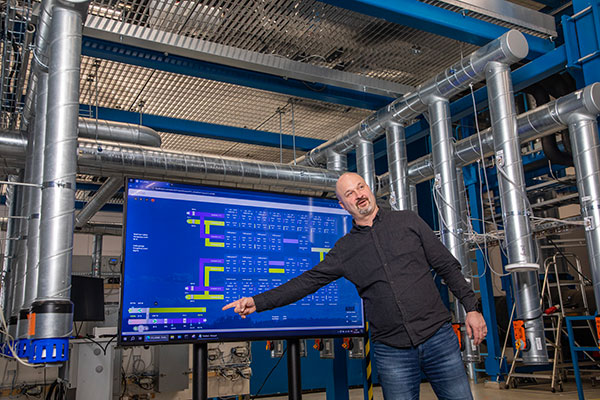
Looking at the three completed Carnival projects, Gabor Gulyas observes that the collaboration was an exercise in strategic alignment. When driving such technology innovation, Carnival is not looking for a traditional vendor, but rather, an agile partner who can match the required pace and vision.
“Taking this project from a small-scale proof of concept to a full-scale integration required immense scalability, technical maturity, and a strictly de-risked confidence level,” he assesses.
“Koja respected our rigorous standards, adapted their software to seamlessly fit our goals, and executed flawlessly within our tight windows. Ultimately, they proved to be a partner capable of scaling with our vision, setting a strong, successful precedent.”
Even greater energy savings ahead
However, there is still an extra ace up Koja’s sleeve – which is likely to translate to even bigger energy savings.
“These three test runs were conducted on the North Sea where the need for air conditioning is not as extreme as in a more tropical climate,” Jere Vähämäki points out. For cruise lines operating in the Caribbean, for example, OBV is sure to bring even more reductions to the energy bill. “We are convinced that we have a hit concept in our hands and are branching out to also newbuild projects,” Vähämäki says.
More information: koja.fi/en/marine