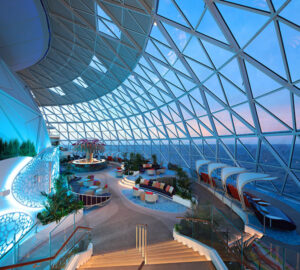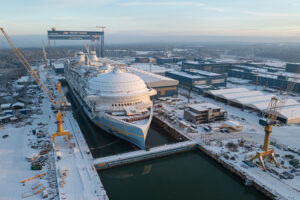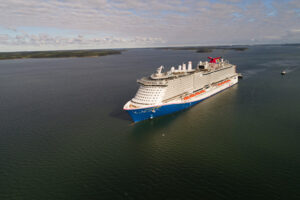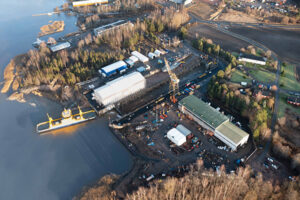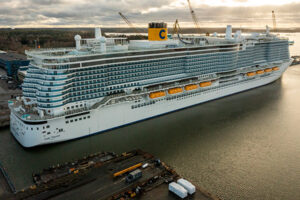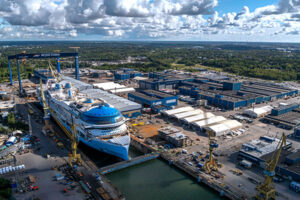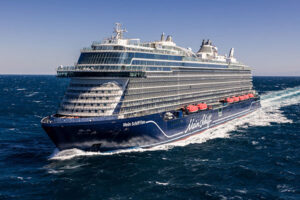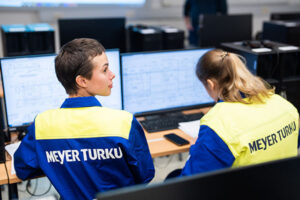
The Star of the Seas is a luxury cruise ship built for Royal Caribbean International and delivered to the customer in June 2025. The ship was constructed at Meyer Turku shipyard in Turku, where Kerabit Pinta was responsible for coating the outdoor decks as well as parts of the interior flooring surfaces.
Deck and flooring surfaces for every purpose
The Star of the Seas is an enormous vessel: 365 metres long and more than 50 metres wide, meaning there was an extensive amount of surface area to coat.
“According to our monitoring charts, approximately 30,000 square metres of coatings were installed,” says Tapio Suikki, Site Supervisor at Kerabit Pinta.
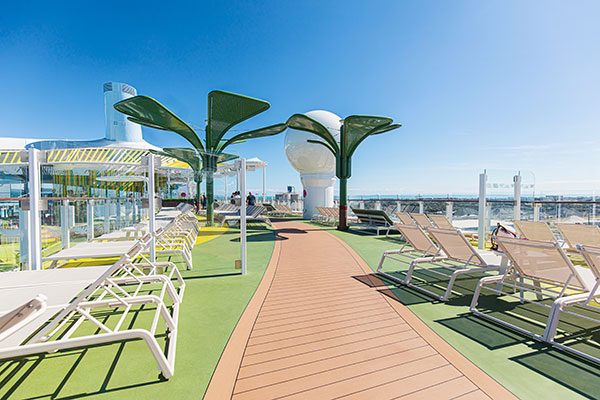
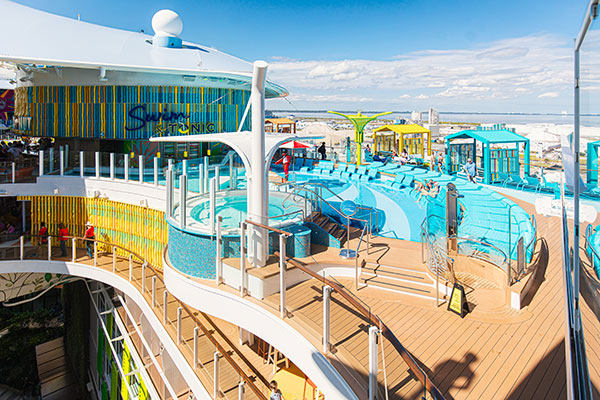
Examples of Kerabit’s workmanship can be seen on the ship’s sun decks and around its swimming pools.
A wide range of different coatings was installed on the outdoor decks. The majority consists of teak imitation surfaces made from polyurethane, designed to look and even feel like real wood.
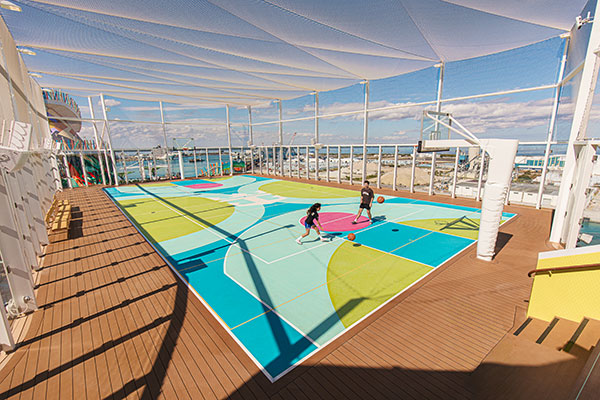
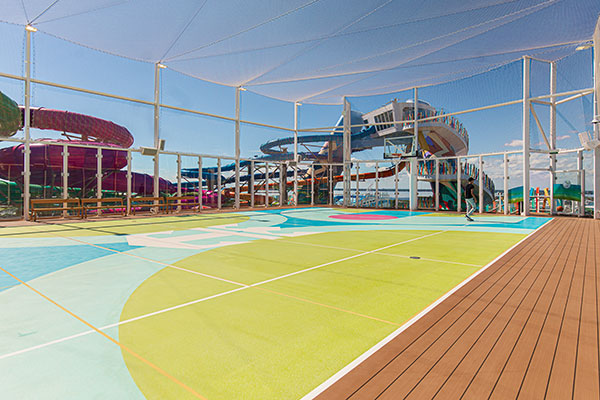
“In addition to teak decks, we also completed running tracks, sports courts, and various poolside and recreation areas. These mainly utilise different polyurethane compounds whose properties are tailored to the intended application. For example, the surfaces used on running tracks and sports courts must be more flexible and resilient than those on ordinary walking decks,” Suikki explains.
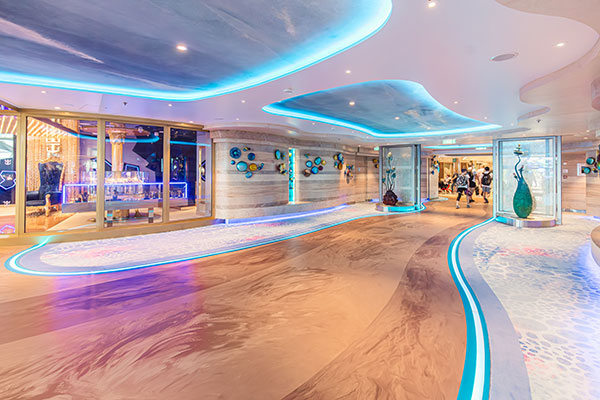
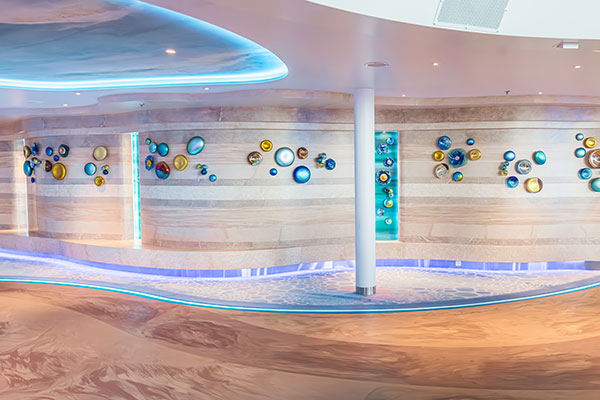
Inside the ship, Kerabit Pinta was responsible for coating floors in areas exposed to heavy wear, such as entrance lobbies. Naturally, a sophisticated appearance is essential in creating the impression of luxury-class quality. Fortunately, polyurethane surfaces can be produced in virtually any appearance desired by the customer.
“There are practically no limitations when it comes to the appearance or colours of the surfaces. One example would be the brown gradient floors in the interior spaces, whose appearance resembles hardwood flooring. They have been sanded slightly rougher than usual and finished with a protective lacquer coating to improve durability.”
As is well known, carefully considered details complete the overall impression and emphasise high quality.
“One of the more distinctive features is the colourful stripes running along the edges of the gradient floors. These are actually colour-changing LED strips embedded into our polyurethane compound, helping to shape the atmosphere and visual identity of the interior spaces.”
Experience brings expertise
Kerabit Pinta is no newcomer to luxury cruise ship deck coatings. Before the Star of the Seas project, the company had already completed coating work on seven Mein Schiff vessels as well as on the Icon of the Seas, the sister ship of Star of the Seas.
“Icon of the Seas is practically identical to Star of the Seas. There are some minor differences in colours and certain details, but otherwise the ships are almost the same,” Suikki says.
The experience gained from the Icon of the Seas project has made work on the subsequent ships in the series easier.
“It has definitely been beneficial that we already had experience from Icon. As they say here at the shipyard, the first vessel in a series is essentially a prototype ship, where everything is new and solutions such as water drainage systems still need to be developed. Building the next one proceeds much more smoothly when you already know the best ways to approach each area,” Suikki explains.
Conditions must be optimal
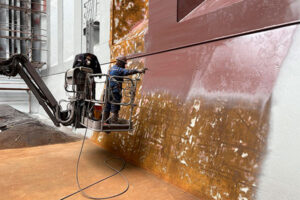
In principle, installing polyurethane coatings always follows the same process. First, the steel deck is sandblasted and roughened to ensure proper adhesion for the primer. After priming, the deck is levelled, followed by the installation of the base layer onto which the surface materials are applied. To achieve a successful result, however, the conditions must be exactly right.
“First of all, the deck temperature must be at least plus ten degrees Celsius. The required humidity level varies somewhat depending on the material, but in practice it should remain below 70 percent.”
To ensure proper installation conditions, the work is carried out under tent structures using various heating systems.
No shortcuts in surface preparation
Tapio Suikki emphasises that achieving a high-quality finish leaves absolutely no room for shortcuts in the preparation work. Any flaws in the substrate will eventually become visible in the finished surface.
“First, we need to ensure that the steel deck is sufficiently rigid before we start applying the compounds. If there is any looseness or movement in the structure, the deck must be reinforced or otherwise secured to make sure it is rigid enough. If the deck starts moving too much in the Caribbean heat, it obviously won’t be good for the coating.
“Once the substrate is in proper condition, every stage of the preparation work must be completed without compromise. Poor sandblasting or grinding, for example, may result in insufficient adhesion for the primer, which naturally means the surface material itself will not bond properly to the deck.”
An eighteen-month project
With 30,000 square metres of surfaces to coat, the project understandably could not be completed overnight.
“Roughly speaking, groundwork on the ship blocks begins about one and a half years before delivery. Then, about eighteen months later, the vessel should be ready,” Suikki estimates.
Completing such a large-scale project also requires a considerable workforce.
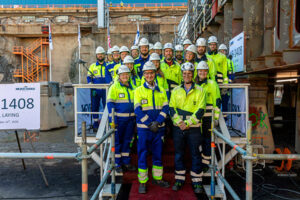
“The number of workers varies depending on the phase of the project. Typically, it ranges between 30 and 50 people. At certain stages more workers are needed, while at others a smaller team is sufficient.”
The next cruise ships already under construction
The Star of the Seas will by no means be the last luxury cruise ship built for Royal Caribbean International.
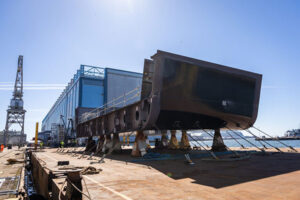
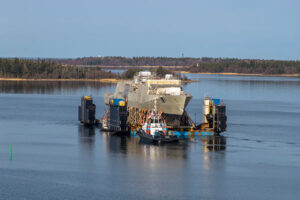
“The third ship in the series, Legends of the Seas, was delivered in early June. Work has also started on the fourth vessel, and its hull is currently being assembled in the construction dock. We aim to complete as much groundwork as possible already at the block stage, so that the conditions are optimal once we begin work on the hull itself,” Suikki concludes.
Even after the fourth ship is completed, work will continue at the Turku shipyard, as the American cruise operator has already ordered a fifth vessel and signed an agreement that includes options for a sixth and seventh ship.
More Information: kerabit.fi/pinta (in Finnish)